Roman Name Generator
A real tria nomina — praenomen, nomen, and cognomen — not a random word mashup.
What is a Roman name generator?
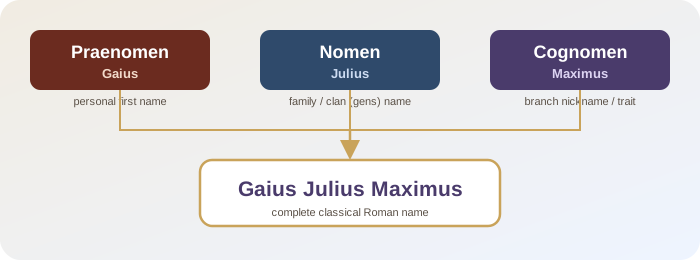
A Roman name generator builds a name using the tria nomina — Latin for "three names" — the real naming structure of ancient Rome: a praenomen (personal first name, like Gaius), a nomen (the name of the person's gens or family clan, like Julius), and a cognomen (a hereditary nickname marking a specific branch of that family, like Maximus). Instead of gluing random Latin-sounding syllables together, this tool pulls from name pools that were genuinely used by Romans and assembles them in the correct order — adjusted for gender and social class.
Praenomen, nomen, cognomen — visually
What makes it work
- Authentic three-part tria nomina structure instead of a random word mashup
- Separate male and female name pools — Roman women were traditionally named after the feminine form of their father's gens, not given a full male-style tria nomina
- Three social-class presets — Patrician, Plebeian, and Military — that shift which nomina and cognomina appear
- Every result ships with a one-line note on what the cognomen would have meant
How to use the Roman name generator
- 1
Choose Male or Female.
- 2
Choose a social class — Patrician, Plebeian, or Military — to shift the style produced.
- 3
Select "Generate Roman names" to get 30 full names with a short meaning note on each.
- 4
Copy your favorite and generate a new batch anytime — free, no limit.
Roman naming mistakes worth avoiding
- Giving a female character a full male-style tria nomina — most Roman women used one or two names, not three.
- Mixing eras carelessly — a name style common under the early Republic can feel out of place for a late-Imperial setting, so keep it broadly consistent.
- Forgetting the cognomen was originally a nickname — using an oddly modern-sounding one can break the illusion for readers who know the convention.
- Skipping the nomen entirely — for most historical or fictional contexts, the family name is what actually signals status and lineage.
Frequently asked questions
What is the tria nomina?
The tria nomina, Latin for "three names," was the standard naming structure for a Roman citizen man: a praenomen (personal first name), a nomen (his gens or family clan name), and a cognomen (a hereditary nickname marking a specific family branch). Read more on Roman naming conventions on Wikipedia.
Did Roman women have three names too?
Usually not. A Roman woman was typically known by the feminine form of her father's nomen — a daughter of the Julii, for instance, would be called Julia — sometimes followed by a birth-order marker like Secunda for "the second," rather than a full male-style tria nomina.
Are these real historical names or invented?
The praenomina, nomina, and cognomina in each word bank are drawn from names genuinely used in ancient Rome. The specific full-name combination this tool produces, however, is randomly assembled and not necessarily a documented historical individual.
Can I use this for a D&D or gladiator character?
Yes — the Military class preset in particular leans toward battle-ready cognomina that work well for gladiator, legionary, or historical-fiction characters.
Is there a limit to how many times I can generate?
No. Generate as many batches as you like — it's free, with no account and no signup.